Double Deep Q-Learning (DDQN)
Using Deep RL to land a Lunar Module
In a world with so many ML milestones being broken, few areas capture my attention as much as Reinforcement Learning. In this project, I implemented Double Deep Q-Network (DDQN), a reinforcement learning algorithm introduced by DeepMind in their seminal paper “Deep Reinforcement Learning with Double Q-learning”.
DDQN is an extension of the original DQN algorithm that addresses the problem of overestimation bias in Q-learning. The key idea behind DDQN is to decouple the selection of the action from its evaluation. This is achieved by using two separate networks: one for selecting the best action and another for estimating its value.
The theory behind DDQN can be summarized as follows:
- Maintain two Q-networks: a primary network and a target network.
- Use the primary network to select the best action.
- Use the target network to estimate the Q-value of that action.
- Periodically update the target network with the weights of the primary network.
I applied this DDQN algorithm to the Lunar Lander environment from OpenAI Gym, a complex control task where an agent must learn to safely land a spacecraft on the moon’s surface. The results were impressive, with the agent learning to consistently land the module after several hundred episodes of training.
You can find the full implementation and detailed results in my GitHub repository, as well as in the ‘repos’ section of my website. The code includes the DDQN implementation, training loop, and visualization of the learning progress.
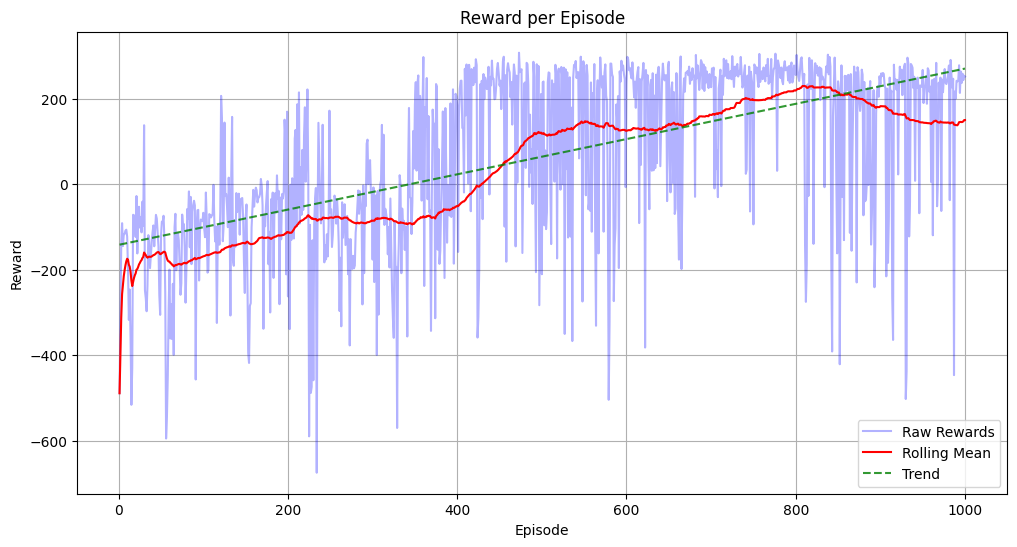
The results indicate that the optimal training duration is approximately 800 episodes. Beyond this point, a decline in performance suggests overfitting. It’s worth noting that at this stage, the mean rewards per episode consistently exceed 200, which aligns with OpenAI’s definition of having ‘solved’ the environment:
The usage is quite simple, all of it being done through a jupyter notebook:
import numpy as np
import gymnasium as gym
from matplotlib import pyplot as plt
from DDQN import QNet
Initialize environment
env = gym.make('LunarLander-v2')Set hyperparameters
n_episodes = 1000
max_steps = 1000
replay_buffer_size=10000
replay_batch_size=32
switch_every=64
epsilon=0.05
decay=0.999
discount=0.99
burn_in=64
min_epsilon = 0.005
Instantiate and train the model
model = QNet(env, replay_buffer_size, replay_batch_size, switch_every, epsilon, decay, discount, burn_in, min_epsilon)

rewards = model.train(n_episodes, max_steps, verbose=True)
burning in buffer... Episode 000 --- reward = -739.5141666252357 Episode 025 --- reward = -188.1888875498531 Episode 050 --- reward = -191.0736901899793 Episode 075 --- reward = -249.45887536816707 Episode 100 --- reward = -72.14476851994712 Episode 125 --- reward = -75.9065433324972 Episode 150 --- reward = -82.66800247376263 Episode 175 --- reward = -14.180993773072984 Episode 200 --- reward = 31.000353716322792 Episode 225 --- reward = 168.261781845259 Episode 250 --- reward = 187.55666508466086 Episode 275 --- reward = 253.42665016846215 Episode 300 --- reward = 286.1116199729371 Episode 325 --- reward = 231.31886869681824 Episode 350 --- reward = 254.12757369746856 Episode 375 --- reward = 263.59126432055933 Episode 400 --- reward = 260.1207790861598 Episode 425 --- reward = 283.8387958750268 Episode 450 --- reward = 217.87501979278073 Episode 475 --- reward = 228.645228195457 Episode 500 --- reward = 223.8858696170921 Episode 525 --- reward = 11.698856971162726 Episode 550 --- reward = -42.6058693312912 Episode 575 --- reward = 228.65056253321566 Episode 600 --- reward = 219.3362709907592 Episode 625 --- reward = 223.05062618310006 Episode 650 --- reward = 254.61655322642517 Episode 675 --- reward = 227.8033467346654 Episode 700 --- reward = 234.59543229213446 Episode 725 --- reward = 33.36721486143995 Episode 750 --- reward = 21.85173587111555 Episode 775 --- reward = -229.7740997425979 Episode 800 --- reward = -125.76888296524649 Episode 825 --- reward = 247.2585396245698 Episode 850 --- reward = -29.040989632208323 Episode 875 --- reward = 172.98225059396916 Episode 900 --- reward = -106.82557715871349 Episode 925 --- reward = 178.74296992510233 Episode 950 --- reward = 233.3913426045845 Episode 975 --- reward = 75.4584025767428 Model saved to trained_ddqn_model.pth